
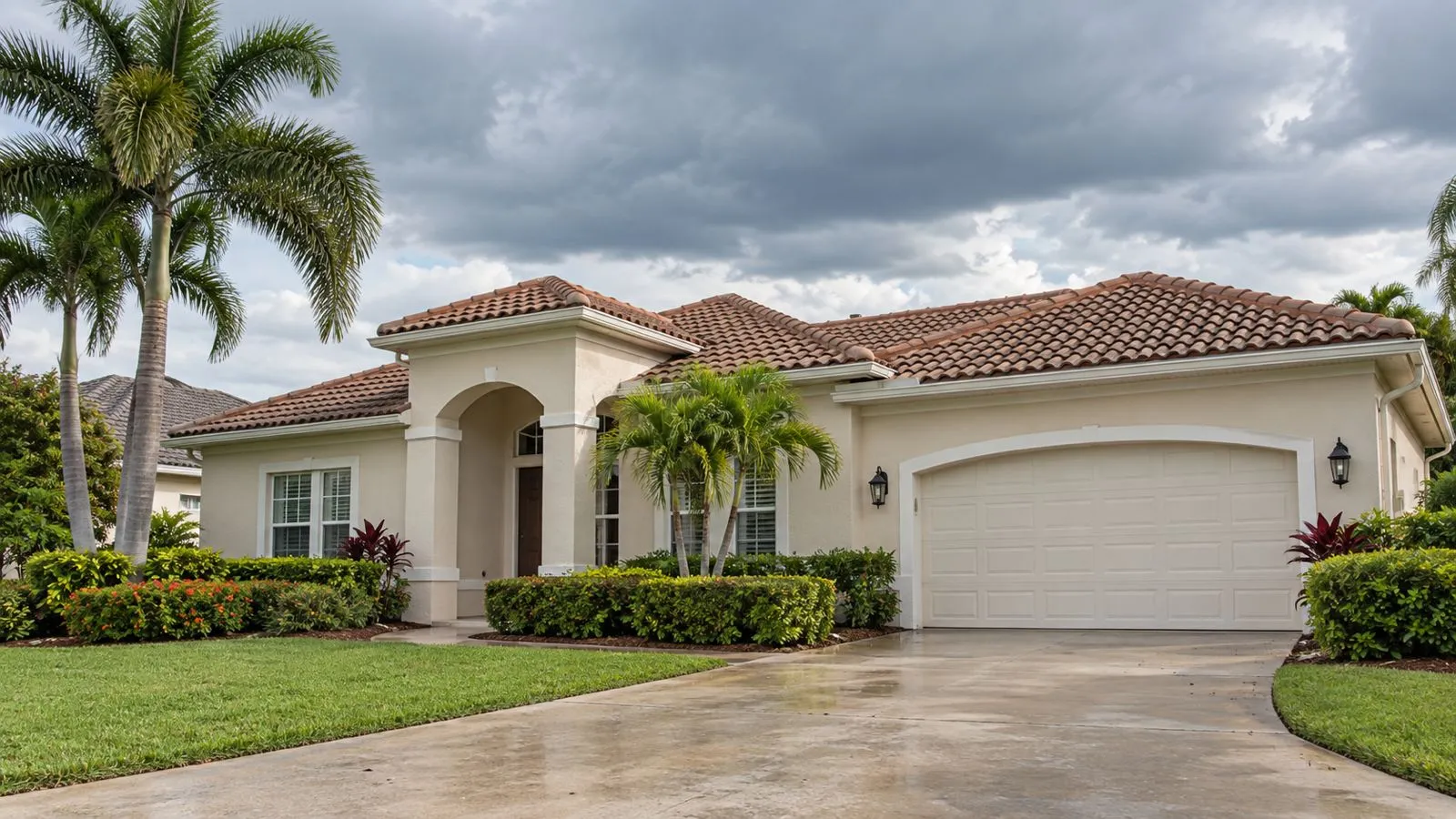
Many South Florida homeowners put off exterior painting because of the rainy season, and some rush it because a dry week has finally shown up. Neither instinct is a good guide on its own. Whether a given day works depends on the paint being used, how dry the surface actually is, and what the surface needed before any paint went on.
This guide is for homeowners and property managers who are planning exterior painting, or trying to judge a proposed schedule. It does not replace the instructions for a specific product, and it is not a how-to for doing the work yourself.
What South Florida weather changes
The National Weather Service in Miami describes a rainy season that starts in late spring and ends in mid-October. In its climate study of Miami records, about 69 percent of the year’s rain fell in that stretch, and showers and thunderstorms were almost a daily occurrence. Heat and humidity stay high through the season, and the NWS says the summer dew point typically sits in the lower to middle 70s.
Some things follow from that, and others do not.
- It does not mean nothing can be painted between May and October. Rain arrives in bursts, and the timing varies. The NWS notes that in an easterly wind pattern, coastal areas tend to get late-night and morning showers while afternoon storms favor the interior. A crew or a schedule can work around that.
- It does mean a single dry forecast is not enough. Surfaces that got soaked yesterday, dew overnight, and a storm two hours after the last coat all matter to how the paint cures.
- Cold is rarely the issue during the rainy season. Paint labels often list a minimum temperature, but the more relevant concerns here are rain, moisture on the surface, and heat and direct sun.
The paint’s instructions set the window
There is no universal number for humidity, temperature or drying time. Requirements differ from one coating to the next, so the label and technical data sheet for the product being used are the authority. Two manufacturers show how the same kinds of limits appear in different forms.
- Sherwin-Williams’ exterior application FAQ is general guidance, and it points readers to the label of the product they are using. It says most products need at least four hours of dry time before moisture settles on the surface, and that ideally the temperature stays above the dew point for 48 hours after application. It also recommends avoiding direct sunlight, especially in hot summer months, because paint that dries too quickly can cause brush marks, lap marks and poor adhesion.
- Product data sheets are more specific. The data sheet for Benjamin Moore’s 100% Acrylic Exterior Low Lustre Finish (542) gives early rain resistance of 1.5 to 2 hours under stated conditions (77 °F and 50 percent relative humidity), a maximum surface temperature at application of 100 °F, and a note that high humidity and cool temperatures lengthen dry and recoat times.
These are examples, not rules. The figures above belong to that one product, and other products, surfaces and primers can have different limits. The practical takeaway is to ask which product and which primer are planned, and to have the painter explain how their schedule fits that product’s instructions.
Dry means dry, and the surface decides
After rain, the question is not whether the sky has cleared. It is whether the surface is ready. Sherwin-Williams’ guidance is that a masonry or wood surface absorbs more moisture from a soaking rain than aluminum or vinyl siding, that it would wait at least a day after heavy rain, and that too much moisture in the surface will most likely lead to peeling. That is one manufacturer’s guidance for its own products, but the principle is a fair one to raise with any painter: how do you decide the surface is dry enough?
Look at the surface before you pick a date
A walk around the outside will tell you a lot about the scope of the work, and about which parts belong before the painting.
- Peeling, flaking or bubbling paint. It usually means the existing coating is not holding, and that the cause is worth understanding.
- Chalky residue. If you rub a hand across the paint and color comes off, note it. Manufacturers list chalk among the things surfaces should be free of before painting.
- Cracks, gaps and open joints, especially around windows, doors and trim.
- Stains and discoloration, including streaks below rooflines, gutters and window corners.
- Soft, swollen or crumbling areas in wood trim, fascia or stucco.
- Dark or green patches, which could be dirt, mildew or something else. You cannot tell from a photo, and neither can this article.
- Places that stay wet, or that are stained again soon after being cleaned.
Take dated photos of what you find. They make it easier to compare quotes, and to show a professional exactly where you saw each issue.
A note on older homes: EPA says that renovation, repair or painting work in a home built before 1978 can easily create dangerous lead dust if the home has lead-based paint, and it recommends that homeowners hire a lead-safe certified contractor for such projects. If your home is that old, that is a reason not to scrape or sand peeling paint yourself.
Fix the moisture problem before you paint over it
Fresh paint can cover a stain, but it does not fix whatever caused it. If an area is stained, damp, soft or repeatedly discolored, the useful question is where the water is coming from. That is a diagnosis for a professional, not something to decide from how the surface looks.
Moisture that shows up inside can point the same way. A stain on a ceiling or an interior wall can trace back to a roof, a window, a drain line or an air conditioning problem, which is covered in who to call for a ceiling water stain.
On mold, EPA’s guidance is direct: do not paint or caulk moldy surfaces, clean up the mold and dry the surface before painting, and paint applied over moldy surfaces is likely to peel. EPA also says that if mold is a problem, you need to fix the water problem. Large or persistent mold is something to have assessed by a professional, not something to paint over.
Interior painting is a different question
Outdoor weather windows do not apply to a room, so an interior job has more scheduling freedom. Moisture still matters, though, in the same ways. An existing stain still needs its source found before it is covered. High humidity indoors can also slow drying, as the manufacturer note above says, and EPA suggests keeping indoor humidity below 60 percent, ideally between 30 and 50 percent. If you are preparing a unit between occupants, the order of repairs and painting is covered in what to check first before the next occupant.
What to discuss with a painting professional
Before a date is set, these questions turn a vague plan into a useful one.
- Which paint and primer will be used, and what do the manufacturer’s instructions say about application conditions?
- What repairs does the surface need first, and who will do them?
- How will the surface be judged dry enough after rain?
- What happens to the schedule if it rains, or if dew is forming in the morning?
- Is anything on the exterior suspected of holding moisture, and has someone looked at the source?
- Does the scope cover the areas you photographed, and what is left out?
If you want a second set of eyes
ServXpress offers painting and repairs and maintenance services in South Florida, coordinated through one team, which is useful when a surface needs repairs before it needs paint. Property managers looking after several properties can also see how PropertyCare coordinates ongoing maintenance. If you are planning a painting project, you can describe the property, or send photos, by email at service@servxpress.com or through the contact page.